
Tombstone
Born: March 8, 19131Powers Heads Federal League, The Reading Eagle, Mar. 9, 1913
Folded: December 22, 19152Majors, Feds, Minors, Sign Treaty of Peace, The Toronto World, Dec. 23, 1915
First Game: May 6, 1914 (W 7-4 @ St. Louis)3Federdal League Has Enthusiastic Opening, The Pittsburgh Gazette Times, May 7, 1913
Last Game: October 3, 1915 (W 3-0 vs. Pittsburgh Rebels)
FL Pennant: 1915
Stadiums
DePaul Field (1913)
Opened: 1898
Closed: 1955
Weeghman Field (1914-1915)
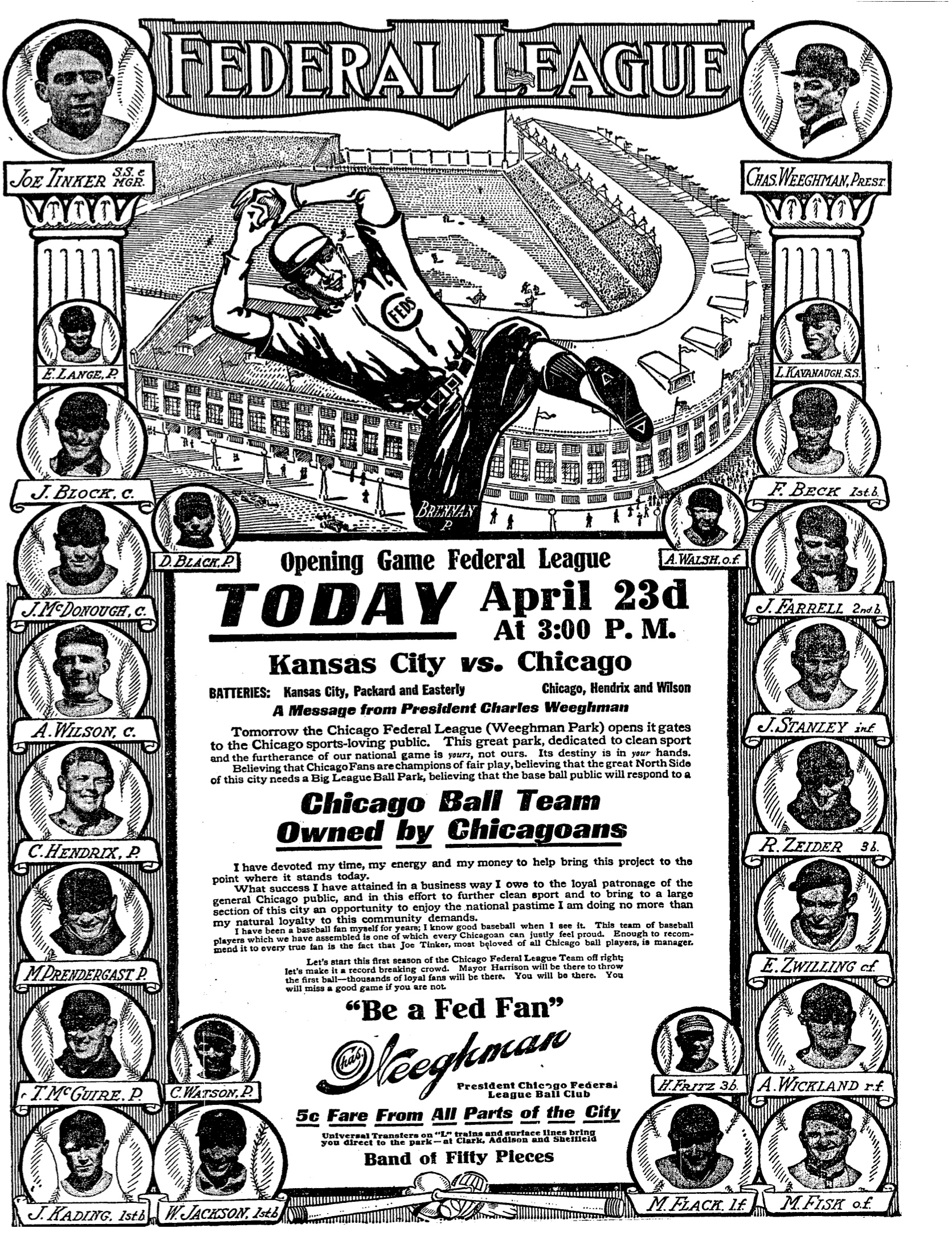
Opened: April 23, 19144Kansas City Beaten, The Saskatoon Phoenix, Apr. 24, 1913
Ownership
- Charles L. Sherlock, Edward C. Racey et al. (1913)
- Charles Weeghman & William Walker (1913-1915)
Marketing
Team Colors:
Blue, white (1913-1914)
Blue, white, red (1915)
Attendance
Background
The Chicago Whales baseball team was established in 1913 as part of the Federal League (FL). The FL was originally organized as a minor league with teams in six cities, including Chicago.
The Windy City entry was backed by Charles L. Sherlock and Edward C. Racey. The team had no official nickname and was sometimes referred to as the Keeleys after manager Burt Keeley, a former pitcher for the Washington Nationals of the American League. The Keeleys, also known as the Chicago Federals or Chifeds, played their games on DePaul University’s athletic field. They finished in fourth place with a record of 57-62.
A third major league
Though they only paid minor league salaries to their players, for the most part, sparse attendance led to all six FL clubs losing money. Despite the red ink, the owners decided to expand by two teams for the 1914 season and, more importantly, declared major league status. Spearheading that bold move was commissioner James Gilmore, who had taken over that position from league founder John Powers halfway through the season.
One of Gilmore’s first initiatives was finding owners with deeper pockets, particularly for the Chicago franchise. For the Windy City nine, he approached restaurateur Charlie Weegham, who just happened to be looking into buying a professional baseball team. Gilmore explained that for an investment of $50,000, Weegham could buy into the Federal League, with that initial cost covering all expenses. Weegham pulled in fish merchant William Walker after realizing, almost immediately, that the $50,000 Gilmore quoted wasn’t going to be nearly enough to bankroll a successful organization.
Signing star players
As fall rolled into winter, the Federal League officially declared major league status, and it was Weegham and Walker who made the first serious attempt to hit the existing big leagues hard. The Chicago Chifeds, as they were known in the press, approached Joe Tinker, who had spent 11 seasons with the Chicago Cubs before being acquired by the Cincinnati Reds for the 1913 season. The Reds sold him to Brooklyn, but the Chifeds offered Tinker an unheard of $36,000 over three seasons with a $12,000 signing bonus.
Organized Baseball (the American League and National League, collectively) immediately formulated a response led by Cubs owner Charles Murphy. The plan was to offer Weegham and Walker to simply go away to the tune of $27,000 each. Tinker then would sign with Brooklyn of the National League for $32,500. Weegham gave the deal some thought because he was dissatisfied with the other FL owners’ lack of commitment and, more importantly, lack of dollars.
Gilmore and the other owners pulled him back in. Weegham didn’t take much convincing, as he really wanted to own a major league baseball team. However, Organized Baseball had a counteroffer: Weegham would be awarded a Chicago franchise in the American Association (AA), a top minor league, as part of a plan hatched by AA president Thomas Chivington and Cleveland Indians owner Charles Somers. Every owner in the AL and NL signed off on the deal except one– Cubs owner Charles Murphy.
The reserve clause
After that deal fell apart, Weegham and his FL cohorts proceeded to try to acquire players. They hoped to have great success by signing players whose contracts with an NL or AL team had ended and were tethered to that team by a provision known as the reserve clause.5Ban Johnson Hopes Feds Will Prove Successful, The Day, Dec. 13, 1913 This clause stipulated that a player had to re-sign with the same team, unless they were sold or traded to another team. Though this was not legally enforceable, all 16 Major League teams observed it. Years later, the reserve clause would be challenged by rebel leagues in other sports in the 1960s and 1970s, and in Major League Baseball by Cincinnati Reds and St. Louis Cardinals great Curt Flood in 1969.
For players in 1914, though, there was little recourse. Many players signed with the FL, only to wind up back with their original AL or NL club, usually after being coerced in some manner. Even when the Federal League sued the players to honor the contracts they had signed with the rebel league, the courts sided with the players, in effect cementing the reserve clause.
Wrigley Field is born, but not under that name
Still, the Federal League teams were able to stock their rosters and prepare for Opening Day, 1914. However, Weegham’s club needed a ballpark as the athletic grounds at DePaul University, where the team played its home games in 1913, were not sufficient for a major league baseball team.
Through Mike Cantillon and Edmund Archanbault, owners of the Minneapolis Millers of the American Association, Weegham found a spot of land on Chicago’s North Side at the corner of West Addison Avenue and North Clark Street. He then turned to Zachary Taylor Davis, who had designed Comiskey Park, to draw up plans for the Chifeds’ new home, Weegham Field.
Weegham didn’t need anything as palatial as Comisekey Park, one of the finest ballparks of the era; he just needed a solid facility, and he needed it quickly. Ground was broken on March 4, and the first pitch was thrown on April 23.6Kansas City Beaten, The Saskatoon Phoenix, Apr. 24, 1914 The Chifeds finished the FL’s first major league season with a record of 87-67, a game and a half behind the pennant-winning Indianapolis Hoosiers.
In September, as the 1914 season was winding down, Weeghman, aided by his buddy Mike Cantillon and Robert Ward, owner of the Brooklyn Federal franchise, was angling to buy the Cubs. Ward was after the AL’s New York Yankees or the NL’s Boston Braves. As part of the plan, most of the FL teams would have been assigned to the top minor leagues, either the AA or the International League. Most of the FL ownership groups, harboring major league aspirations of their own, vetoed the plan.
A ceasefire between the FL and the two established leagues vanished, and the upstart circuit went back to trying to sign away players from the AL and NL. In January of 1915, the FL sued Organized Baseball on antitrust grounds, a move that would also be used by later rebel leagues in several sports.
The Chicago Whales win the pennant
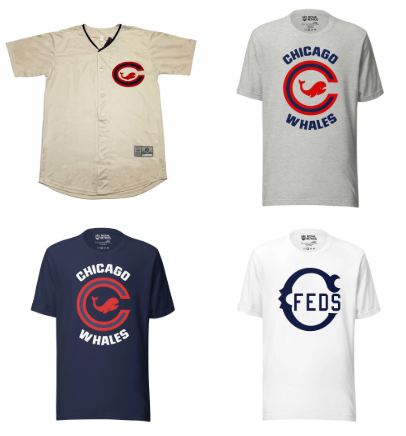
A month later, the Chifeds were renamed the Whales7Sporting Items, The Dayton Leader, Feb. 12, 1915 and proceeded to march to the 1915 FL pennant. On Sunday, October 3, a crowd of 32,212 packed Weegham field to watch the Whales split a doubleheader with the Pittsburgh Rebels. The split allowed the Whales to capture the flag by a mere percentage point over the St. Louis Terriers. It was the last hurrah for the Whales and the Federal League. Most of the teams were near bankruptcy. The owners who did have money were able to buy into existing teams in the AL and NL, including Weegham, who went on to purchase the clubs. Unfortunately, his once deep pockets were now mostly filled with lint, a condition that led him to put together a syndicate that included chewing gum magnate William Wrigley Jr.
The Cubs promptly moved from their shabby, wooden West Side ballpark to Weegham Field, where they’ve been ever since. In 1918, after Wrigley gained majority control of the frnchise, the stadium was renamed Wrigley Field.
Additional sources:
Whales, Terriers, and Terrapins, The Federal League 1914-15, Edited by Steve West & Bill Nowlin, Associate Editors Carl Richardson & Len Levin, Society for American Baseball Research, 2020.
The Federal League of Baseball Clubs, by Robert Peyton Wiggins, McFarland & Company, 2009.